
India is all set to make its presence felt in the $47 billion global outsourced semiconductor testing and packaging market, an arena where Malaysia and Vietnam have been way ahead so far. The Cabinet last Thursday cleared two projects, the Tata's assembly testing and packaging plant (ATMP) and the Murugappa-owned CG Power with Renesas from Japan as its tech partner. These, together with Micron's assembly and testing plant which is already being constructed in Sanad in Gujarat, will collectively invest Rs 47,300 crore to set up the factories.
A task force set up by the Ministry of Electronics and Information Technology (Meity) for transforming India into an "electronic and semiconductor products" nation is on the verge of finalising its report, which is likely to recommend an allocation of Rs 44,000 crore between 2024 and 2030 to support homegrown companies in their quest to develop products and build global brands. The task force's recommendations include significant incentives: Rs 15,000 crore dedicated to electronic products (systems), Rs 11,000 crore for semiconductor products, and Rs 18,000 crore for various other incentives such as talent development, common infrastructure, logistics, and technology & IP (intellectual property) acquisition, a member of the panel revealed.
India and Vietnam are vying with each other to woo semiconductor companies to their country. With the tension between the US and China escalating, and Taiwan getting vulnerable both countries are trying to present themselves as alternative destinations for global players. Vietnam, which started the effort as early as 2010, has got a leg-up after US President Joe Biden's visit last month.

Micron plans an assembly testing, marking and packaging project of $1 billion, and talks are on to set up a memory chip plant for captive requirements.

'Foreign capital will continue to come directly into India, but companies have realised that GIFT City is a more cost-efficient way of channelling funds.'

The government is close to approving a proposal by Micron Technology to set up an assembly, testing, marking and packaging (ATMP) facility in the country involving an investment of about $1 billion. The world's fifth largest semiconductor company, based in Idaho, USA, will use the facility to process some of its own wafers, manufactured across the globe.
Dixon Technologies has received approval from the Indian government to form a joint venture (JV) with Chinese peer Longcheer, according to a regulatory filing. The JV will be formed between Dixon and Longcheer's Singapore-based subsidiary.

The exit of Larsen & Toubro (L&T) from the Hyderabad Metro is a long-term positive for the stock. It could be a bullish trigger, alongside higher international orders, and new opportunities in segments like defence and data centres.

'The real story of 2025 is that India officially stopped being a 'market of the future' and started acting as the world's primary economic engine.'

Showcasing India as an attractive investment destination, Modi said the country has political and economic stability as well as transparency and predictability in policy decisions.

'Those trying to use these funds for quick gains should avoid them due to risk of being late to the party.'
The Union Cabinet on Wednesday approved a Rs 76,000 crore policy boost for semiconductor and display manufacturing ecosystem in the country in an bid to position India as a global hub for hi-tech production. Announcing the decision of the Cabinet, IT and Telecom Minister Ashwini Vaishnaw observed that electronics plays an important role in everyday life, and semiconductor chips forms a crucial part of electronics. Outlining the details of the scheme, he said the Rs 76,000 crore programme has been approved for the development of semiconductors and display manufacturing ecosystem.
The exclusive club that dominates the global semiconductor fab scenario is about to get a new member. Taiwan, South Korea, and China control nearly 70 per cent of the global capacity. SEMI, the global industry body for semiconductor and electronics design and manufacturing, projects all fabs collectively will churn out 30 million wafers a month this year.

'India needs many more job creators, both in manufacturing and services, to make it big.' 'For that, the red carpet must be rolled out fully and for all investors without holding back,' suggests Nivedita Mookerji.

After months of discord, the Tata Trusts appear to be moving towards reconciliation, with recent reappointments and open exchanges signalling a return to cooperative governance.

...compared with 153,000 in all of 2024.

Japanese automaker Suzuki Motor Corporation will invest Rs 70,000 crore in the next five to six years in India to strengthen its operations in the country, its representative director and president Toshihiro Suzuki said on Tuesday. Prime Minister Narendra Modi on Tuesday kicked off exports of Maruti Suzuki India's first electric vehicle e VITARA to 100 countries and also inaugurated the production of lithium-ion battery cells for strong hybrid electric vehicles at its facility in Gujarat.

A day before US President Donald Trump's additional 25 per cent tariff kicks in, Prime Minister Narendra Modi on Tuesday made a vehement pitch for swadeshi and Make in India that should help create jobs in the country.

Essential and strategic items such as pharmaceuticals, semiconductors, copper, and energy products like oil, gas, coal and LNG are exempted from the 27 per cent import duty announced by the US on Wednesday, according to think tank GTRI.

Two modules published by the NCERT, Swadeshi: Vocal for Local (for middle stage) and Swadeshi: For a Self-Reliant India (for secondary stage), carry excerpts from the prime minister's Independence Day address in which he stressed that self-reliance would drive India's journey towards a Viksit Bharat.

Union telecom minister Jyotiraditya Scindia on Tuesday said investment in India at present makes economic sense for every original equipment manufacturer, as he cited the example of US smart devices major Apple's decision to source majority of the iPhones sold in the US from the country. While speaking at the Bharat Telecom event, Scindia said the investment in India at present is not just an act of goodwill alone but it makes economic sense for every OEM (original equipment manufacturer).

These are 'hidden champions' of strategic research and innovation. They are worthy of emulation within Indian industry, and maybe even a Padma!, notes R Gopalakrishnan.
Indian conglomerate Vedanta has earmarked $15 billion for foray into the electronic chip and display manufacturing space, and plans to scale up the investment to as much as $20 billion, a senior company official said. Vedanta's group firm Avanstrate, which will spearhead the semiconductor business, expects to roll out electronic chips and displays from Indian manufacturing plants by 2025, the official of the group's semiconductor arm said on Friday. "Semiconductor is a long-term business. We are looking at about $10 billion on display.

Open order books in February breach 700,000; wait period for some models exceed a year.

Apple will source the majority of the iPhone sold in the US from India in the June quarter while China will produce the vast majority of the devices for other markets amid uncertainty over tax tariffs, a top official said on Friday.
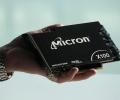
Computer storage chip maker Micron will set up a semiconductor assembly and test plant in Gujarat entailing a total investment of $2.75 billion (around Rs 22,540 crore), the company said on Thursday. Micron will invest up to $825 million in setting up the plant in two phases. Micron's plant has been approved under the government's "Modified Assembly, Testing, Marking and Packaging (ATMP) Scheme,".

Any industrial policy is only as good as how it is applied and the other reforms that support it. This was as true 40 years ago as it is now, points out Debashis Basu.

A Rs 23,000-crore production-linked incentive (PLI) scheme for electronic components may boost margins and enable a broader product mix.

Let's work flat out and create a policy framework that fosters the growth of Indian non-family business VC and private equity firms. This will allow our Indian startups' dreams to flourish, explains Ajit Balakrishnan.

Prime Minister Narendra Modi urged CEOs of US majors to take advantage of India's growth story as the country is making all efforts to become the third largest economy of the world in his third term. India is currently the fifth largest economy of the world after the US, China, Germany and Japan with a GDP of around $3.9 trillion. India has been the fastest growing large economies of the world with GDP growth rate of over 7 per cent for the last three consecutive years.

Infra major's entry could queer the pitch for Jaypee and Hindustan Semiconductor.

India took another leap in space infrastructure with the foundation stone laid for a new launch pad at the country's second rocket port in Kulasekarapattinam.

Tata Group is in discussions with some major international companies, including those from Taiwan, for its foray into the semiconductor chip business. The Union government had earlier tried to bring in Taiwanese manufacturers Taiwan Semiconductor Manufacturing Company (TSMC) and United Microelectronics Corporation (UMC) for chip manufacturing in India. A person close to the development said the Tatas have now opened a separate channel for a possible tie-up. Currently, India mostly imports chips, which are fabricated and assembled to put into various applications, including automobiles, renewable power, mobile phones, televisions, and other electronic items.
Mining mogul Anil Agarwal-led Vedanta Resources' credit profile will unlikely be weighed down by the group's planned Rs 1.54 lakh crore foray into semiconductor manufacturing, S&P Global Ratings said on Monday. "This is because the company has reiterated that the $20 billion related investment will be carried out outside of Vedanta Resources. "The business will be undertaken in a separate entity under Vedanta Resources' holding company Volcan Investments Ltd," it said.
Two full-fledged semiconductor fabrication plants are going to come up in India very soon entailing multi-billion dollar investment besides several chip assembly and packaging units, Minister of Electronics and IT Rajeev Chandrasekhar said. In an interview with PTI, the minister confirmed that the two projects include a $8 billion proposal submitted by Israel-based Tower Semiconductors and the other from Tata Group. "I am happy to share this with you and you are probably the first one I'm sharing this with.

Corporate India is starting to step up its capital expenditure plans amid government incentives and signs of rising demand, company executives and analysts have indicated. This coincides with the Reserve Bank of India (RBI) recently citing a double-digit growth in private capital expenditure. Healthy balance sheets of banks and corporates, along with increasing capacity utilisation and improving business sentiment, are contributing to a favourable environment for sustained growth in private sector investments, the RBI said in its policy last week.

Gor underlined that President Trump has a "deep friendship" with Prime Minister Narendra Modi, and that is something that is unique.

Their favourite alternatives: Malaysia, Vietnam and the Philippines. Note, India is missing from that list. And this is despite an attractive financial incentive scheme for OSAT players. The reason, said a senior executive of a US chip company who had a meeting in Taiwan just a few weeks ago, is that "they want more predictability in government policy because they plan to put in big money."
US-based chipmaker Micron Technology is expecting demand for semiconductors to rise significantly in the next few years, globally and in India, as memory consumption is going up, largely driven by the widespread adoption of technologies like artificial intelligence (AI). "Memory consumption is expected to double by the end of the decade and the biggest driver in this is AI. "While it's natural to talk about compute and GPUs (graphics processing units) in the context of AI, it is not to be forgotten that the true enabler for AI is memory ... in all the AI engines that we talk about, there is a lot of need to access memory quickly," Anand Ramamoorthy, managing director, Micron Technology India, told Business Standard.

With inflation comfortably below the Reserve Bank of India's (RBI's) 4 per cent median target and likely to undershoot its 3.7 per cent projection for 2025-26 (FY26), there is room for the monetary policy easing cycle to be sustained, the Finance Ministry said on Monday. The comments, featured in the ministry's Monthly Economic Review for June 2025, assume significance ahead of the Monetary Policy Committee (MPC) meeting of the Reserve Bank of India (RBI) scheduled to begin from August 5.
